
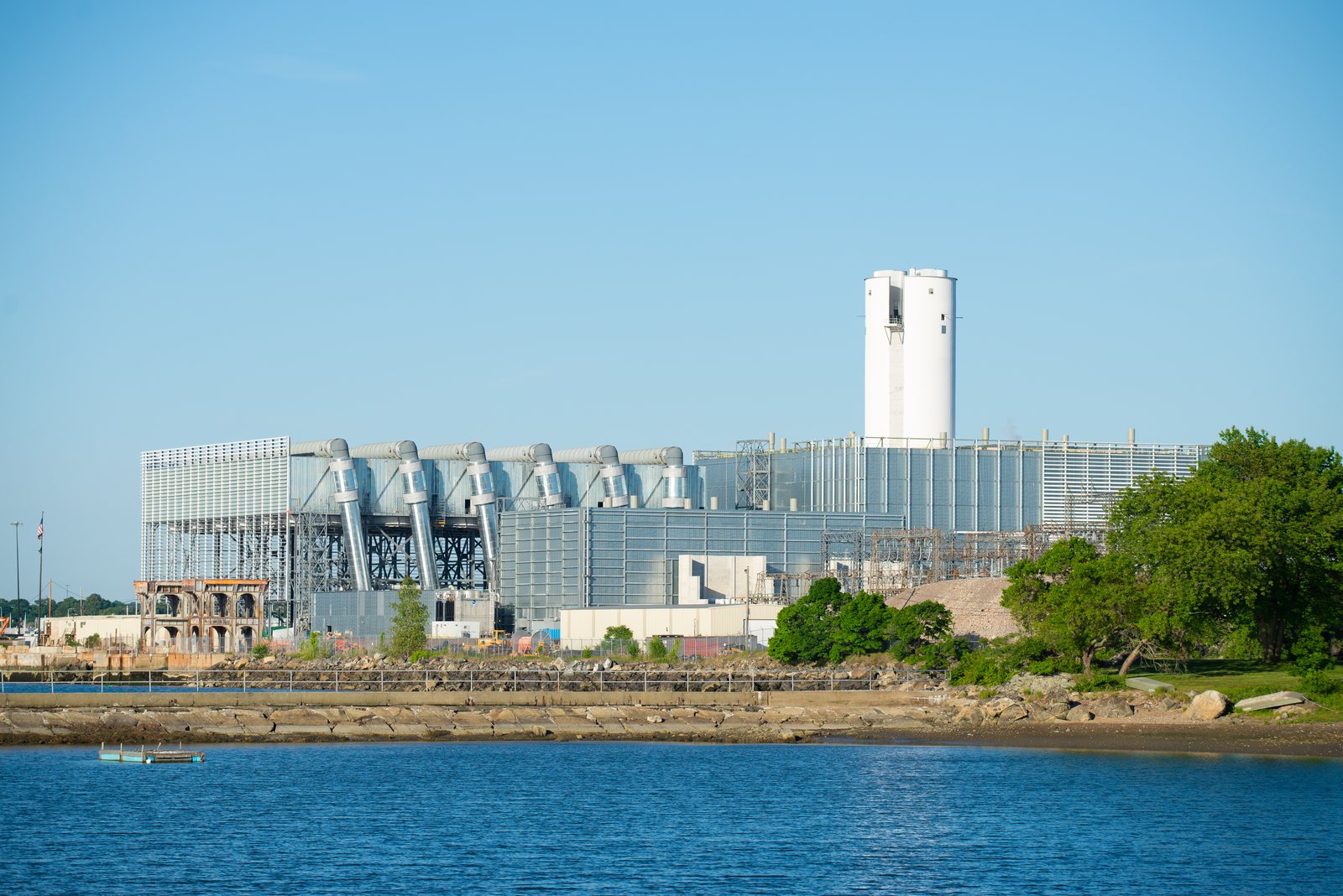

TAYLOR, Texas — August 19, 2026 — When Taylor Planning & Zoning commissioners questioned Project Mustang representatives about placing a massive power-generation facility near existing homes, Big Watt representative John Stokes pointed to a previous project.
“The last one I built was in the middle of downtown Salem Massachusetts.”
Salem is a relevant comparison. It is not necessarily a reassuring one.
The modern Salem Harbor Energy Center is a roughly 674-MW natural-gas combined-cycle plant inside an established city. But it was built on a harbor site that had already hosted major coal- and oil-fired generation for decades.
Project Mustang would present a different land-use question. Big Watt has discussed an initial concept of approximately 1,040 MW of on-site generation serving roughly 700 MW of data-center demand on currently rural land east of Taylor, with City materials describing as many as 84 to 112 natural-gas generating units.
That is roughly 54% more generating capacity than Salem Harbor — and potentially a very different mechanical system.
Salem required real noise mitigation
Salem was not simply placed in a city and assumed to be compatible with its neighbors.
A later arbitration record involving the project says a berm and gabion wall had to be completed before successful far-field noise testing. The record documents acoustic testing tied to project requirements and acceptance.
If Salem is the example Project Mustang wants Taylor to consider, then Taylor should ask what equivalent protections will be mandatory here: enclosures, silencers, barriers, setbacks, testing and enforceable post-construction limits.
Salem also shows why normal-operation noise is only part of the issue.
During commissioning in 2018, nearby residents complained about exceptionally loud steam-release events. Contemporary local reporting quoted one resident comparing the sound to a large aircraft hovering over her home. Plant representatives said those events were associated with commissioning and pressure-release testing rather than normal daily operation.
That distinction is important. It does not establish that Salem operates at aircraft-like sound levels every day. It does show why Taylor should require Project Mustang noise analysis to address commissioning, startup, shutdown, testing, maintenance, black-start events and emergencies — not just steady-state operation.
xAI may be the more relevant modern warning
For Project Mustang’s technology and operating model, xAI’s expanding AI-computing power system near Memphis, Tennessee, and Southaven, Mississippi, may be the more useful comparison.
Unlike Salem’s conventional combined-cycle plant, xAI has deployed numerous individual natural-gas turbines to provide dedicated power for AI computing. Reuters reported in July that regulatory communications identified 59 installed turbines associated with xAI’s expanded Colossus 2 project, while Mississippi regulators separately approved construction of 41 permanent gas-fired turbines.
Residents near the Southaven site have reported persistent mechanical noise, including nighttime sound and intermittent louder events. Reuters reported that equipment could be heard around the clock in a nearby neighborhood, that residents compared some louder events to jet engines, and that one resident said the noise woke him at night.
Those accounts are resident observations, not regulatory findings that xAI violated a particular noise limit.
A class-action lawsuit has also alleged that xAI, SpaceX and a related entity created a nuisance through persistent noise and vibration. Those claims remain allegations.
Still, the comparison matters. A Project Mustang campus containing dozens of generators could combine sound from combustion equipment, exhaust systems, cooling fans, transformers, pumps, gas infrastructure, battery systems and diesel backup generation.
That is why Taylor should know whether Mustang’s acoustic study will evaluate low-frequency sound, tonal noise, nighttime conditions, dBC measurements and actual nearby homes — not merely one overall dBA number at a property line.
The air-permitting dispute matters too
xAI’s experience also illustrates how behind-the-meter generation can create complicated air-permitting questions.
Reuters reported that xAI installed dozens of temporary turbines without securing federal air permits, while xAI and Mississippi regulators have argued that temporary or mobile turbines receive different treatment. Environmental organizations have challenged that position in federal court. The legal dispute remains unresolved.
For Taylor, the lesson is not that Project Mustang will violate air-quality laws. It is that a campus containing dozens of generating units should be evaluated as a complete industrial system.
Residents still need a final campus-wide inventory showing expected emissions — including nitrogen oxides, carbon monoxide, particulate matter and other regulated pollutants where applicable — and the permit limits that will actually govern the main generation fleet.
That is especially important after Stokes clarified during the Aug. 18 hearing that Tier 4 standards apply to Project Mustang’s emergency or standby generators, not the main natural-gas power plant.
The burden should be on Project Mustang
Stokes’ Salem statement may be completely accurate. Salem proves a large gas-fired plant can operate inside a city.
But the fact that another plant exists near homes does not establish that Project Mustang will be compatible with the people already living around it.
The actual question is whether this specific roughly 1-GW private-power campus has been designed, modeled and legally constrained to prevent unreasonable impacts on neighboring property owners.
Before approvals advance, Taylor should require at minimum:
- A cumulative noise study covering the entire generation and data-center campus.
- Modeling at actual nearby homes, including nighttime, low-frequency and tonal sound.
- Analysis of commissioning, startup, shutdown and emergency conditions.
- Exact turbine, engine and diesel-generator models and quantities.
- A campus-wide emissions inventory and applicable air-dispersion analysis.
- Binding setbacks, acoustic mitigation, post-construction testing and an enforceable remedy if real-world performance exceeds predictions.
From a property-rights and limited-government perspective, nearby residents should not be required to absorb the risk if a private hyperscale project’s assumptions prove wrong after construction.
Salem is worth studying because Big Watt raised it.
xAI is worth studying because it may more closely resemble the emerging many-turbine AI-power model.
Taylor should require Project Mustang itself to prove that its scale, equipment and protections are compatible with its neighbors before either example is used as reassurance.
Sources
- Wilco Liberty Project — Aug. 18 Project Mustang P&Z hearing coverage
- IDOM — Salem Harbor 674-MW project description
- Salem Harbor arbitration record — far-field noise testing
- Salem Patch — 2018 commissioning-noise complaints
- Reuters — xAI turbines, permitting and neighborhood noise reporting
- Reuters — Southaven nuisance lawsuit
- Mississippi DEQ — permanent turbine approval record
Photo license and attribution are also listed on Wilco Liberty Project’s Image Credits page.