
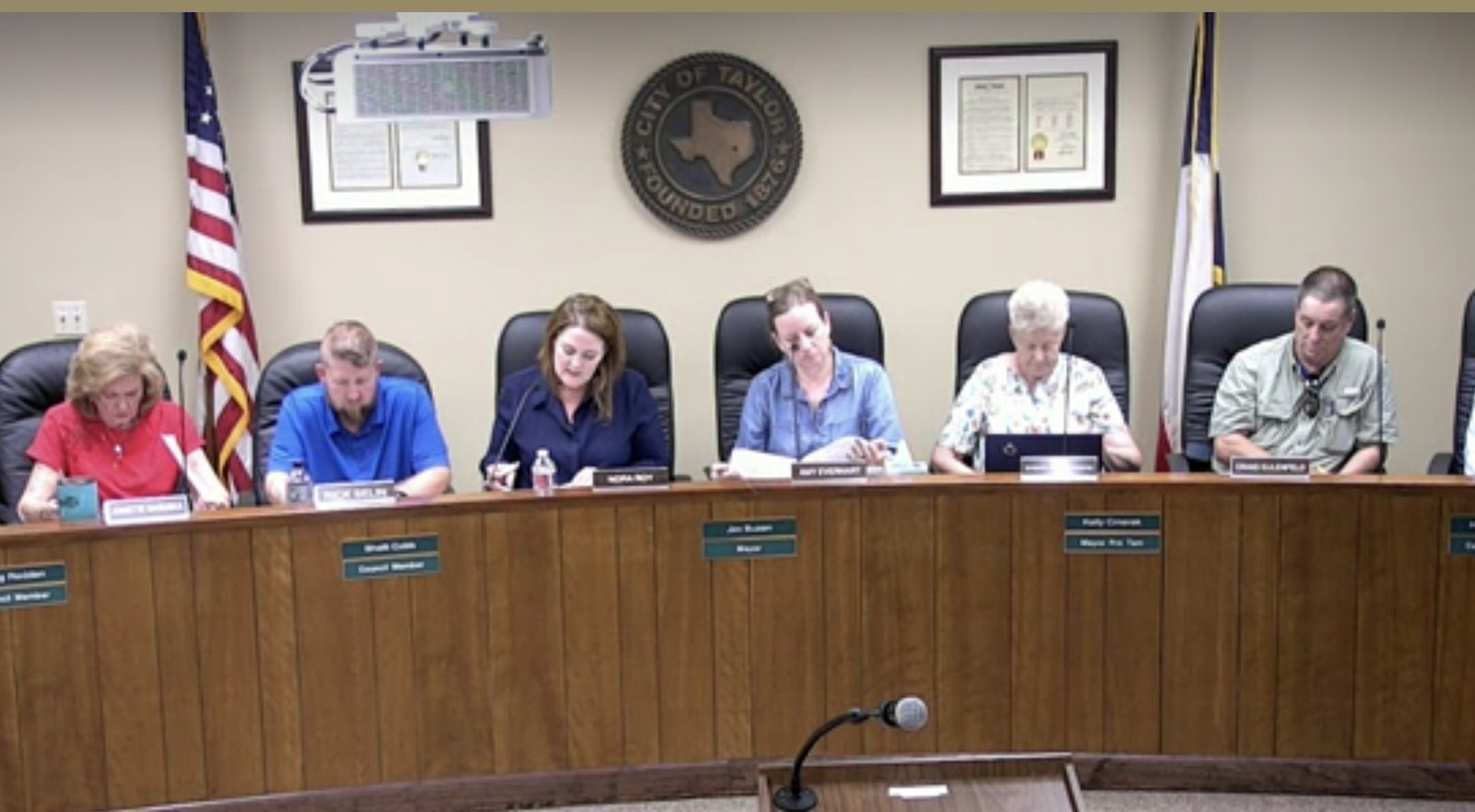
TAYLOR, Texas — August 18, 2026 — The Taylor Planning & Zoning Commission voted Tuesday to table Project Mustang’s Employment Center Plan for 90 days, delaying action after a lengthy public hearing that revealed significant new details about the proposed data-center and power-generation campus east of Taylor.
During the hearing, Project Mustang representatives disclosed an initial expectation of approximately 1,040 megawatts of on-site generation, an approximately 700-megawatt data-center load, and potential natural-gas consumption of as much as 200 million cubic feet per day.
Commissioners questioned representatives about whether the proposal is effectively a major power plant paired with a data center, how it would connect to the electric grid, what emissions controls would apply, how battery and industrial emergencies would be handled, and what protections would exist between the project’s power infrastructure and nearby rural residences.
One of the most consequential statements came from John Stokes of Big Watt Digital, who told commissioners that although the applicant prefers annexation into Taylor, Project Mustang intends to proceed even if the City does not annex the property.
The Commission ultimately declined to move the Employment Center Plan forward Tuesday and instead tabled it for 90 days. That decision gives commissioners, City staff, the applicant and the public additional time to address a substantial list of unresolved technical and regulatory questions that surfaced during the hearing.
Annexation preferred — but applicant says project would continue without it
City staff told commissioners that Project Mustang is currently in Taylor’s extraterritorial jurisdiction and that the applicant has requested voluntary annexation.
Staff said the annexation request was expected to go before the Taylor City Council on September 10, 2026.
The Employment Center Plan under consideration Tuesday is part of the broader development process, which staff said would later move through preliminary platting, infrastructure improvement plans, final platting, site-development review and building permits.
But Stokes told the Commission that the project’s future does not depend entirely on annexation. In substance, Stokes said annexation into Taylor is the preferred outcome, but Project Mustang would still be pursued if annexation does not occur.
He did not establish during the hearing exactly what regulatory path, permitting structure, utility arrangement or land-use framework the project would use in that scenario. That remains an important unanswered question.
The Commission’s 90-day tabling also creates a new procedural question: whether the City’s previously anticipated September 10 annexation schedule will remain unchanged or be affected by the delay. No conclusion should be drawn until the City formally clarifies the schedule.
Who represented Project Mustang
Project Mustang participants expressly identified during the hearing included:
- John Stokes — Big Watt Digital, described as part of the project’s power and utility team
- Matt Lissak — Kimley-Horn, associated with site and civil engineering
- PowerHouse representatives, identified by Stokes as the project’s development partner
- Kimley-Horn representatives, identified as the project’s civil engineering team
Stokes answered many of the Commission’s detailed questions concerning power generation, natural gas, grid interconnection and related infrastructure.
About 1,040 MW of generation for a 700 MW data-center load
One commissioner pressed Stokes for a clear figure for Project Mustang’s planned generation capacity after different numbers had circulated publicly.
Stokes responded that the project’s initial expectation is approximately 1,040 MW of generation serving approximately 700 MW of data-center load.
City materials have described approximately 84 to 112 natural-gas generation units as contemplated for the site, along with separate diesel emergency or standby generators. Stokes told commissioners that the primary generation fleet may use a combination of natural-gas turbines and reciprocating engines.
The development also contemplates battery energy storage systems, substations, a gas yard, black-start generators, urea storage, fuel-oil storage and exhaust stacks reaching approximately 125 feet.
Project plans to begin isolated from the electric grid
Stokes told commissioners that Project Mustang initially plans to operate fully isolated from the electric grid, generating the electricity required by the campus itself.
A commissioner questioned that description after Stokes discussed the possibility of future grid interaction. Stokes said the project expects to begin as a self-supporting system but left open the possibility of later interconnection if regulatory rules, timing and economics allow.
According to Stokes, Project Mustang is targeting operation around 2028, while a useful grid interconnection may not become available until approximately 2030 or later. The project’s ultimate relationship with the ERCOT grid therefore remains unresolved.
‘A power plant with a data center attached’
One commissioner characterized the proposal as appearing to be “a power plant with a data center attached” and asked what permitting would be required for the power plant.
Stokes said air-emissions permitting would be the primary regulatory requirement associated with the natural-gas generation facility.
The exchange highlighted an important distinction: Project Mustang is not proposing only conventional backup generators associated with a data center. Its primary power system would itself be a major industrial component of the development.
Natural-gas demand could reach 200 million cubic feet per day
Commissioners also asked how much natural gas Project Mustang could require. Stokes estimated maximum demand at approximately 200 million cubic feet per day.
Commissioners questioned the project’s relationship to pipelines crossing the property. Stokes described one existing pipeline and another planned adjacent pipeline and discussed anticipated pipeline capacity.
Those capacity figures were statements made by the applicant and should not be treated as independently verified commitments until supported by pipeline-company records, interconnection agreements or other primary documentation.
Existing land records independently confirm that a Matterhorn Express pipeline easement crosses the principal Project Mustang property. Final gas-supply arrangements, contracted capacity and delivery commitments remain unresolved publicly.
Tier 4 clarification: not the main gas power plant
One of the hearing’s most significant clarifications involved emissions standards.
City materials and public descriptions have referred to Tier 4 emissions standards in discussing Project Mustang. A commissioner asked whether Tier 4 applied to the project’s primary power plant.
Stokes clarified that Tier 4 applies to the emergency or standby generators — not the main natural-gas generation plant.
A commissioner responded that the distinction mattered because residents had been told the project would meet those higher standards. The main Project Mustang natural-gas generation plant therefore should not be characterized as Tier 4 based on Tuesday’s hearing.
A commissioner also challenged Stokes’ characterization of natural gas as very clean, pointing out that natural-gas generation still produces nitrogen oxides and other regulated emissions. Stokes said the project would be subject to applicable air-emissions permitting.
Battery storage details still undetermined
Battery energy storage systems, or BESS, are planned for the project. When a commissioner asked what equipment and capacity would be used, Stokes said the engineering had not yet been completed.
He did not identify a final manufacturer or capacity. Open questions therefore include total battery capacity, battery chemistry, manufacturer, physical configuration, separation distances, fire-suppression systems and emergency-response procedures.
Fire and emergency response
Commissioners questioned Project Mustang about emergency response involving battery storage, industrial chemicals, natural-gas generation and electrical equipment.
Stokes said the project intends to have trained personnel, on-site firefighting equipment, hydrants, pumps and containment systems and said the project is coordinating with local fire officials.
No completed project-wide emergency-response plan was presented during the hearing. The applicant therefore described planned capabilities, but final staffing, equipment, response procedures and agency responsibilities remain to be documented.
No universal power-plant setback, Stokes says
A commissioner asked what setback typically exists between a power plant and residential property. Stokes said there is no universal standard and emphasized engineering and noise mitigation instead.
That left unresolved one of the central land-use questions involving Project Mustang: What enforceable minimum separation will ultimately apply between the project’s primary power-generation facilities and existing nearby homes?
Public commenters also questioned language protecting property that is formally residentially zoned, noting that existing homes on rural or ETJ property may not necessarily have residential zoning.
Noise: 65 dBA or the existing baseline, whichever is greater
City staff described the proposed noise standard as 65 dBA at a residential property line or the pre-development level, whichever is greater.
An acoustic baseline study would be performed and provided to the City. Public commenters questioned whether that methodology sufficiently addresses nighttime rural conditions, persistent low-frequency hum, tonal noise, dBC measurements, octave-band analysis and temporary events such as trains, traffic or wind that could elevate the measured baseline.
The presentation did not identify a separate nighttime dBC limit or a specific low-frequency or tonal-noise standard.
Reuse water and initial fill
Project Mustang representatives said the developer would pay for proposed infrastructure needed to deliver reuse water.
City staff said reuse water would be used for initial system fill and described an initial fill limit of approximately 5 million gallons per building system.
Staff also described a mechanism under which the City Manager could authorize domestic water use if reuse infrastructure is delayed. Four existing domestic wells are proposed to remain for customary domestic uses.
Those statements add detail to the proposed water strategy, but final infrastructure agreements, enforceable usage limits, construction schedules and contingency arrangements remain subject to later documentation and engineering.
Transportation plans remain in development
City staff showed Taylor’s existing transportation plan, proposed Industrial Boulevard along the western side of Project Mustang, Williamson County’s long-range future arterial along the eastern side, and a proposed realignment of that County roadway associated with the project.
Recently obtained Williamson County records provide additional context. Those records show Kimley-Horn and County engineers discussing alternative arterial alignments and County requirements involving a 136-foot future County right-of-way, 45-mph design geometry, U.S. 79 connectivity, Atlas 14 floodplain limits, pipeline easements, north-south corridor connections and nearby homes and structures.
The County records document technical coordination. They do not establish final Williamson County approval of either proposed realignment.
City staff also said a formal Traffic Impact Analysis would be required before the preliminary plat stage. That means a major analysis of traffic effects remains scheduled for a later development phase unless a separate completed TIA is identified.
Public comment focused on unresolved protections
Speakers raised concerns about the Employment Center land-use designation, requests for delay or a moratorium, protections for nearby rural residences, low-frequency and nighttime noise, emissions, traffic, drainage, emergency response, water use and the number of significant technical issues being deferred to later stages.
One speaker specifically questioned whether protections tied to “residentially zoned” land would adequately protect existing rural homes on unzoned or ETJ property.
Another speaker challenged the City’s previous position that it could not pause data-center development and cited Fort Worth’s moratorium process. That was presented as a public legal and policy argument, not an established legal conclusion applicable to Taylor.
Big Watt says it is not seeking subsidies or abatements
Stokes told commissioners that Project Mustang is not asking for subsidies or tax abatements.
That is an important public representation by the applicant. It does not by itself resolve whether there have been discussions involving economic-development agreements, infrastructure commitments, reimbursements, waivers or other potential benefits.
Commission tables plan for 90 days
After the presentation, commissioner questioning and public comments, the Planning & Zoning Commission tabled consideration of Project Mustang’s Employment Center Plan for 90 days.
The delay provides additional time for issues involving emissions, noise, setbacks, battery storage, emergency response, traffic, drainage, water and transportation infrastructure to be examined before the Commission again considers the Employment Center Plan.
It also means the development did not receive Planning & Zoning approval Tuesday night.
The 90-day tabling should not, however, be characterized as a denial of Project Mustang. The application remains pending.
What remains unanswered
- Final TCEQ air-permit status and permitted emissions
- Exact turbine and reciprocating-engine models and quantities
- Final BESS capacity, chemistry and manufacturer
- Final natural-gas interconnection arrangements
- Final acoustic-study methodology
- Specific protections for nighttime, tonal and low-frequency noise
- Power-plant-specific residential setbacks
- Completed Traffic Impact Analysis
- Final drainage and hydrology studies
- Final Williamson County arterial alignment
- The precise regulatory path if Taylor denies annexation
- Any final development or economic-development agreements
- Whether the anticipated September 10 annexation schedule changes because the Employment Center Plan has now been tabled
For now, the clearest result from the August 18 hearing is that Project Mustang remains under review — and Taylor’s Planning & Zoning Commission has chosen to give itself 90 more days before deciding whether to advance the Employment Center Plan.
Wilco Liberty Project distinguishes statements made at the hearing from independently confirmed records. Applicant statements concerning capacity, future operations and planned infrastructure remain attributed unless separately established through source documents.